
7 Front Desk Pain Points a Virtual Medical Assistant Can Fix in 2026
It’s 8:02 on a Monday. Three phone lines are blinking, a patient is at the window holding a new insurance card, and the voicemail counter already reads 41. Somewhere under the pile is a prior authorization that was due Friday. Your front desk team is good at their jobs. There just aren’t enough of them, and every hour they spend on hold with a payer is an hour nobody answers the phone.
A virtual medical assistant can take a large share of that work off the desk. A medical virtual assistant (MVA) is a trained, HIPAA-compliant remote team member who handles a practice’s administrative work, such as phones, scheduling, insurance verification, prior authorizations and referrals, from outside the office, inside your own systems.
This guide covers the seven front desk pain points practices bring to GoLean Health most often, what an MVA does about each one, a real example of the results, and how to choose a partner who stays accountable for performance long after the first day.
Why the Front Desk Breaks First, and How a Virtual Medical Assistant Helps
The front desk breaks first because it absorbs every gap in staffing. When a receptionist leaves, the phones, check-in, eligibility checks and referral handoffs all land on whoever is left.
The numbers back this up. In a May 26, 2026 MGMA Stat poll, 28% of practice leaders reported higher staff turnover than the year before, with churn concentrated in medical assistants, nursing and front desk roles (MGMA). MGMA notes that front desk turnover shows up fast: call abandonment rises, scheduling accuracy falls, check-in slows and referral handoffs lag. Replacing those people is slow, too. In a November 3, 2026 MGMA Stat poll, about four in five practices reported an open administrative position, and 16% said their longest opening had been vacant for six months or more (MGMA).
Front desk roles also compete with retail, hospitality and call centers for the same applicants, which keeps wages climbing while the work keeps growing.
This is where medical front desk outsourcing changes the math. A virtual medical assistant works behind your in-office team, not instead of it. The MVA takes the phone queue, the payer calls and the paperwork, so the person at the window can focus on the patient in front of them. Because GoLean Health places MVAs as dedicated team members rather than a shared call pool, the same person learns your providers, your payers and your patients.
The short answer: a virtual medical assistant adds trained capacity to the front desk without adding local headcount, and without waiting six months to fill a seat.
7 Front Desk Pain Points a Virtual Medical Assistant Can Take Off Your Plate
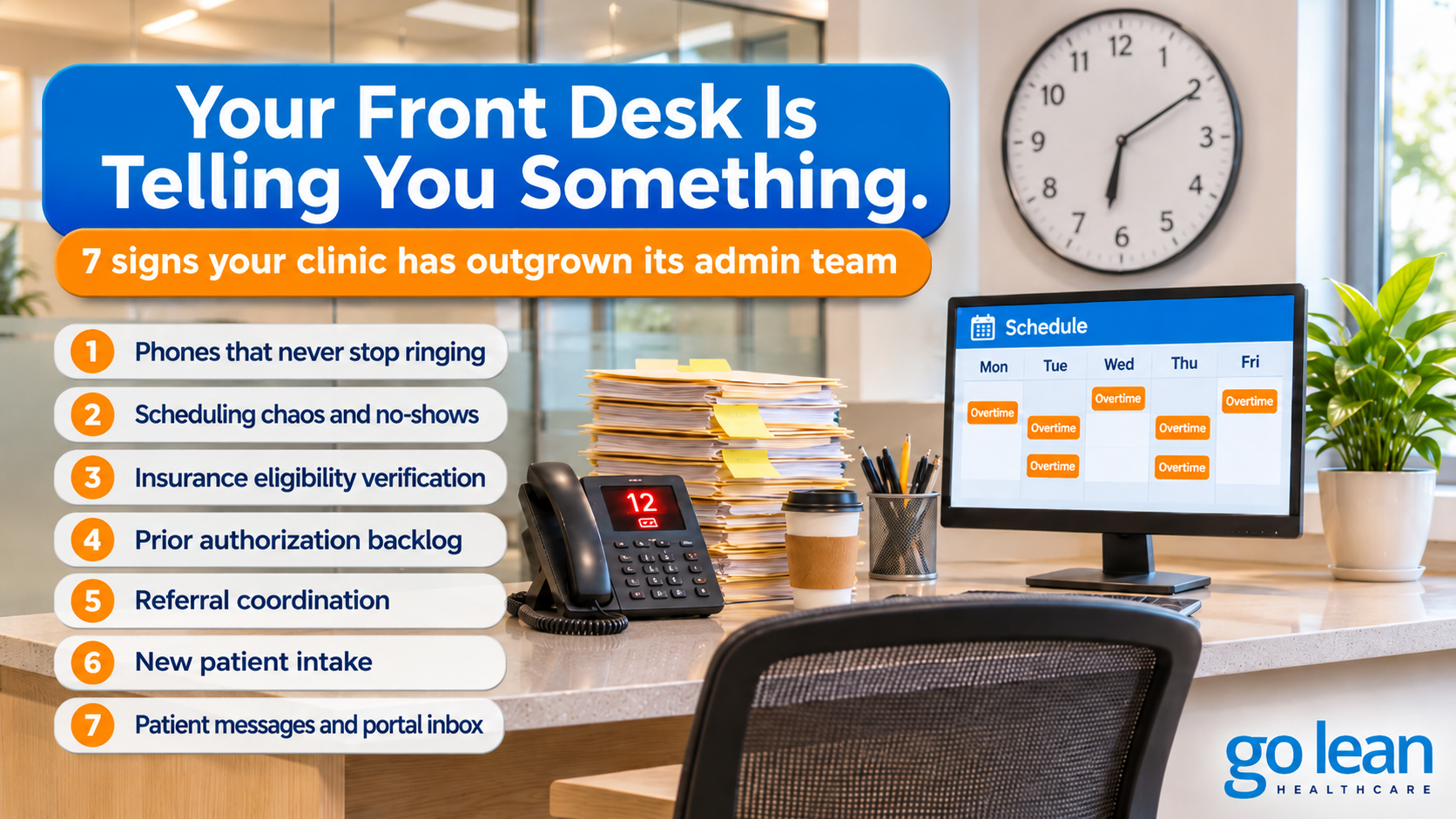
A virtual medical assistant can handle most front desk work that happens on a phone, a screen or a payer portal. Here are the seven pain points we see most, and what changes when an MVA owns them.
| Front desk pain point | What it costs the practice | What the MVA does |
|---|---|---|
| 1. Phones that never stop ringing | Missed new patients, voicemail backlog, frustrated callers | Answers overflow and callbacks, clears voicemail the same day |
| 2. Scheduling chaos and no-shows | Empty slots, double bookings, provider downtime | Confirms, reschedules and fills cancellations from a waitlist |
| 3. Insurance eligibility verification | Denials, surprise bills, copays not collected | Verifies coverage 24 to 72 hours before every visit |
| 4. Prior authorization backlog | Delayed care, staff hours lost on hold | Submits, tracks and follows up on prior auths |
| 5. Referral coordination | Lost referrals, records that never arrive | Chases incoming and outgoing referrals and records |
| 6. New patient intake | Long check-ins, incomplete charts | Sends forms, collects demographics and insurance ahead of time |
| 7. Patient messages and portal inbox | Unanswered messages, refill requests stacking up | Triages messages and routes clinical items to the right person |
1. Phones that never stop ringing
Every unanswered call is a patient who may book somewhere else. An MVA working as a remote medical receptionist picks up overflow calls, returns voicemails and logs every call in your EMR, so nothing depends on someone remembering a sticky note.
2. Scheduling chaos and no-shows
An MVA confirms appointments, reschedules proactively and works a waitlist so a 2 p.m. cancellation becomes a filled slot instead of lost revenue.
3. Insurance eligibility verification
Checking coverage before the visit, not at the window, prevents a large share of front-end denials. The MVA verifies benefits, flags inactive plans and notes the expected copay before the patient arrives.
4. Prior authorization backlog
The 2025 AMA Prior Authorization Physician Survey found practices complete an average of 40 prior authorizations per physician each week, consuming 13 hours of physician and staff time, and 40% of physicians employ staff who work exclusively on prior authorization (AMA). That is exactly the kind of structured, portal-based work an MVA can own.
5. Referral coordination
Referrals fall through when nobody owns the follow-up. The MVA tracks each referral from receipt to scheduled visit and chases outside records before the appointment.
6. New patient intake
Intake forms, demographics and insurance details get collected before the visit, so check-in takes minutes and the chart is complete when the provider walks in.
7. Patient messages and the portal inbox
The MVA sorts administrative requests, answers what can be answered and routes clinical questions to your nurse or provider using your protocols. Your clinical team only sees what needs a license.
What Changes When an MVA Joins the Team: A Real Example
The clearest results come when an MVA owns one bottleneck end to end. One growing specialty practice came to GoLean Health with a familiar problem. New patient demand was strong, but only about half of inquiries turned into booked patients. The front desk was answering calls between check-ins, and follow-up on missed leads simply wasn’t happening.
During the Discovery Call, intake was identified as the bottleneck. GoLean Health placed an MVA with healthcare operations experience and set up EMR access and phone integration before her first day. She built intake SOPs from scratch, documented what moved a caller to a booked visit and tightened the referral handoff.
Within three months, the practice’s lead-to-patient conversion rose from 50% to 70%. The in-office team stopped working through lunch, and the practice manager got back hours each week that had gone to chasing callbacks. Across GoLean Health clients, practices commonly reclaim 15 or more hours per week of administrative time.
The lesson is simple: an MVA delivers the most when the role is designed around a specific problem, not a generic job description.
How to Choose the Right Virtual Medical Assistant Partner
The right virtual medical assistant partner stays accountable for performance after placement, not just until the contract is signed. Plenty of agencies can send you a résumé. Far fewer will still be measuring results in month six. Use these seven criteria to compare providers of virtual healthcare admin support.
- Discovery before a proposal. A good partner asks where your time goes before recommending a role. If the first call is a price sheet, the fit will be generic.
- Healthcare-specific vetting. Ask how candidates are tested on EMR use, insurance terminology, prior authorizations and patient communication, not just English and typing speed.
- Real HIPAA safeguards. Look for HIPAA training and certification for every MVA, a signed Business Associate Agreement, secure VPN access, role-based permissions and activity monitoring. Be wary of anyone who promises “100% secure.”
- Setup handled before day one. The partner should coordinate EMR access, phones and workflows with your team. Expect a realistic ramp of two to four weeks, not instant mastery.
- Ongoing performance oversight. This is the biggest differentiator. Your partner should run regular check-ins, track agreed KPIs such as call answer rate, verification turnaround and prior auth cycle time, and coach the MVA when numbers slip. Oversight should continue for the life of the engagement.
- A replacement guarantee. If an MVA leaves or isn’t the right fit, the partner should replace them quickly and transfer documented SOPs so your workflows don’t reset.
- Overlapping hours and clear escalation. Your MVA should work your clinic hours, with a defined path for urgent items.
| Placement-only agency | Ongoing partner like GoLean Health | |
|---|---|---|
| Role design | Generic job description | Built from a Discovery Call |
| Onboarding | You train from scratch | Systems and SOPs configured with you |
| After placement | Invoice only | Regular check-ins, KPIs and coaching |
| If the MVA leaves | Start the search over | Rapid replacement with documented handoff |
Frequently Asked Questions
What does a virtual medical assistant do at the front desk?
A virtual medical assistant handles front desk work that doesn’t require being physically in the office. That includes answering and returning calls, scheduling and confirmations, insurance eligibility verification, prior authorizations, referral coordination, new patient intake and portal messages. The MVA works inside your EMR and phone system, so your in-office team can focus on patients who are physically present.
How much does a medical virtual assistant cost?
A medical virtual assistant typically costs 50% to 70% less than a comparable in-office hire once wages, benefits, payroll taxes, overtime and turnover are counted. Exact pricing depends on hours, scope and experience level. GoLean Health quotes after a Discovery Call, so the price reflects the role your practice actually needs.
How long does it take to onboard a virtual medical assistant?
Most practices should plan on two to four weeks for a virtual medical assistant to reach full productivity. The first week covers system access, phone setup and SOP review. Weeks two through four build speed on your payers, providers and workflows. A partner who configures your systems before day one shortens that ramp considerably.
How to choose a medical virtual assistant company?
Choose a medical virtual assistant company that starts with discovery, vets candidates for healthcare skills, signs a Business Associate Agreement and enforces HIPAA safeguards. Most importantly, confirm the company keeps overseeing performance after placement through check-ins, KPIs and coaching, and guarantees a fast replacement if the assistant leaves.
Virtual medical assistant vs. in-house receptionist: which is better?
Neither replaces the other. An in-house receptionist is essential for greeting patients, check-in and anything physical. A virtual medical assistant is better suited to phones, payer calls, verification, prior authorizations and paperwork. Most practices get the best results pairing one or two in-office staff with an MVA who absorbs the administrative overflow.
Is a medical virtual assistant HIPAA compliant?
A medical virtual assistant can be fully HIPAA compliant when the provider puts the right safeguards in place. Look for HIPAA training for every assistant, a signed Business Associate Agreement, secure VPN connections, role-based access to patient data and ongoing activity monitoring. Compliance is a process the partner should maintain, not a one-time certificate.
Conclusion
Your front desk isn’t failing because your people aren’t good. It’s failing because the work outgrew the headcount. Three takeaways:
- Phones, scheduling, eligibility checks, prior authorizations and referrals are all work a virtual medical assistant can own end to end.
- The biggest gains come when the MVA’s role is built around your specific bottleneck.
- The partner matters as much as the person. Choose one that keeps measuring and coaching performance after placement.
A virtual medical assistant gives your team breathing room and gives you back time for the work only you can do. If you’d like to see where that time is going in your practice, book a free Discovery Call with GoLean Health. We’ll map your front desk workload and show you what an MVA could take off your team’s plate.
Written by the GoLean Health team, specialists in virtual medical staffing solutions for independent practices.
| TAKE THE PRESSURE OFF YOUR FRONT DESK |
| Your front desk isn’t short on talent. It’s short on hours. A GoLean Health virtual medical assistant takes the overflow calls, eligibility checks, prior auths and referral follow-ups, and we keep tracking performance long after day one.
Book a free GoLean discovery call and tell us which of the 7 pain points hits your practice hardest. Read what practice owners say about GoLean: GoLean testimonials. Learn more at GoLean. |